
 Available in US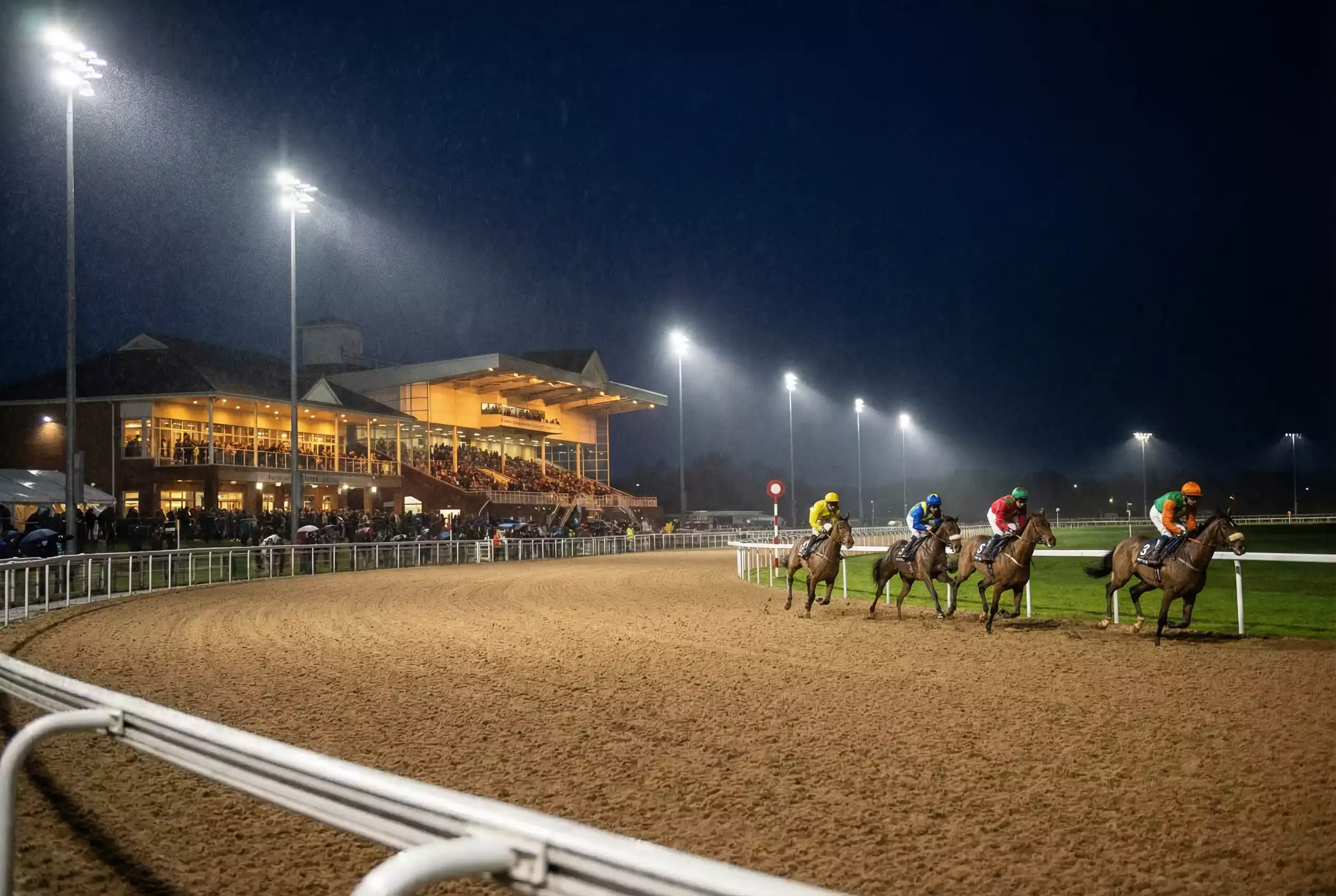
Under the Floodlights at Dunstall Park
Wolverhampton was the first racecourse in Britain to stage racing under floodlights, and evening meetings remain central to its identity. While the turf circuit shuts down at dusk, Dunstall Park keeps going — offering midweek cards that start after most people have finished work and extending the betting day well into the night. For punters who cannot watch afternoon racing or prefer the rhythm of an evening card, Wolverhampton’s floodlit programme is a fixture in the weekly calendar. Wolverhampton Evening Racing — More on this topic at wolverhampton race betting.
But evening racing at Wolverhampton is not simply the same product delivered at a later hour. The fields differ, the class profile shifts, and the dynamics of the betting market change in ways that create specific opportunities and traps. Trainers use evening meetings differently from afternoon fixtures, bookmakers adjust their approach, and the audience — both on-course and watching via live streams — behaves in patterns that shape the odds. Treating a Monday evening card at Dunstall Park the same as a Saturday afternoon at Newmarket is a reliable way to misjudge value.
Evening Meeting Schedule and Pattern
Wolverhampton’s annual programme of more than eighty fixtures is heavily weighted toward evening meetings. The majority of midweek cards start between 4:30pm and 6:00pm, with the last race typically running between 8:00pm and 9:00pm depending on the size of the card. Some meetings push later, particularly in winter when the all-weather programme absorbs demand that turf tracks cannot service. The floodlight infrastructure means there is no practical daylight constraint — the only limits are scheduling agreements with other racecourses and broadcasters.
The weekly rhythm is fairly predictable. Monday and Wednesday evenings are the most common slots for Wolverhampton fixtures, though Tuesday and Thursday cards appear regularly. Saturday meetings are less frequent but do occur, usually as part of a broader all-weather programme when turf racing is limited by weather. The consistency of the midweek schedule is, in itself, a useful feature for regular bettors: it creates a repeatable cycle where the same trainers, jockeys, and types of horses appear week after week, building a dataset that rewards attentive observation.
Fixture density varies by season. The winter months — November through March — see the heaviest concentration of evening meetings, as Wolverhampton picks up fixtures that would otherwise be lost to waterlogged or frozen turf tracks. During the summer, when the turf flat season is in full swing, the evening programme thins out but does not disappear entirely. Some of the summer evening cards attract smaller fields and lower-class races, which has its own implications for betting — a point examined in more detail below.
One scheduling quirk worth noting is the overlap with other all-weather venues. On some evenings, Wolverhampton races concurrently with Kempton, Chelmsford, or Newcastle. When this happens, the available pool of horses and jockeys is split across venues, which can affect field sizes and the quality of the card. Checking the wider evening fixture list before committing to a Wolverhampton card is a small step that helps calibrate expectations.
How Evening Cards Differ from Afternoon Racing
Evening cards at Wolverhampton tend to feature lower-class races than the venue’s afternoon fixtures. The bread and butter of the evening programme is Class 5 and Class 6 handicaps and maiden or novice events, with the occasional Class 4 race adding depth to the card. High-class racing is rare in the evening — the feature races and valuable handicaps are scheduled for afternoon or weekend slots when the television audience is larger and the prize money justifies stronger entries.
Field sizes tell part of the story. The national average for flat racing in 2025 stood at 8.90 runners per race, according to the BHA Racing Report. Wolverhampton evening cards tend to cluster around that average but with more variation: some races attract ten or eleven runners while others, particularly maidens in summer, may go off with five or six. The distribution matters for draw-bias considerations — a twelve-runner evening handicap over 5 furlongs activates the low-draw advantage just as it would in the afternoon, but a five-runner novice event does not.
Jockey bookings shift in the evening. The leading riders — those who command retainers with major yards — are more likely to ride at afternoon fixtures or at rival evening meetings where the prize money is higher. Evening Wolverhampton cards frequently feature younger or less fashionable jockeys who know the track well and ride there regularly. This is not necessarily a disadvantage: a course specialist who rides Wolverhampton twice a week may know its turns and quirks better than a Group 1 rider visiting once a season. Identifying which jockeys consistently perform well on the evening circuit is a worthwhile exercise.
The atmosphere of evening racing also affects the on-course crowd. Midweek evenings draw a different audience from Saturday afternoons — fewer casual racegoers, more regulars and dedicated bettors. The on-course betting ring can be thinner, meaning the Tote pools may be smaller and on-course prices more volatile. For the bettor watching from home, this has little direct impact, but for anyone attending in person, it shapes the on-course experience and the value available through pool betting.
Betting Angles Specific to Night Meetings
The lower class profile of evening racing creates specific betting opportunities. In Class 5 and Class 6 handicaps, the quality gap between runners is narrower than in stronger races, which means form is less reliable as a predictor. This sounds like a problem, but it is actually an opportunity: when form is less decisive, other factors — draw, pace, trainer patterns — carry more weight, and the punter who has done the analytical work gains an edge over those relying purely on the racecard.
Trainer patterns on the evening circuit reward close attention. Some trainers use Wolverhampton evening meetings to give horses a spin under race conditions before targeting a more valuable engagement elsewhere. These runners may not be wound up to win, and their odds may not reflect that. Other trainers genuinely target the evening cards with fit, well-handicapped horses because the opposition is weaker and the prize money — while modest — covers training costs. Distinguishing between these two approaches is possible with a bit of homework: a trainer who consistently places horses at Wolverhampton evenings and has a positive strike rate is targeting; one who sends runners intermittently and rarely wins is using the meetings as prep.
Market behaviour differs at evening fixtures. The afternoon racing audience overlaps with the evening audience, meaning many bettors have already had a full day’s action before the Wolverhampton card begins. Some are chasing losses; others have switched off. The result is that evening markets can be less efficient than afternoon ones, with prices occasionally drifting on runners that deserve support or shortening on horses with no real chance. Steam moves — sudden market shifts driven by informed money — tend to be more visible on evening cards because the overall volume of money is lower, making each significant bet more impactful on the price. See also Handicap Betting at Wolverhampton.
Finally, live streaming gives evening Wolverhampton cards a visibility that they would not have had a decade ago. Most major bookmakers stream the races live, which means bettors can watch the racing and assess conditions in real time. If you are betting in-play or simply want to check how the track is riding before the later races, streaming is a practical tool that complements the data.
