
 Available in US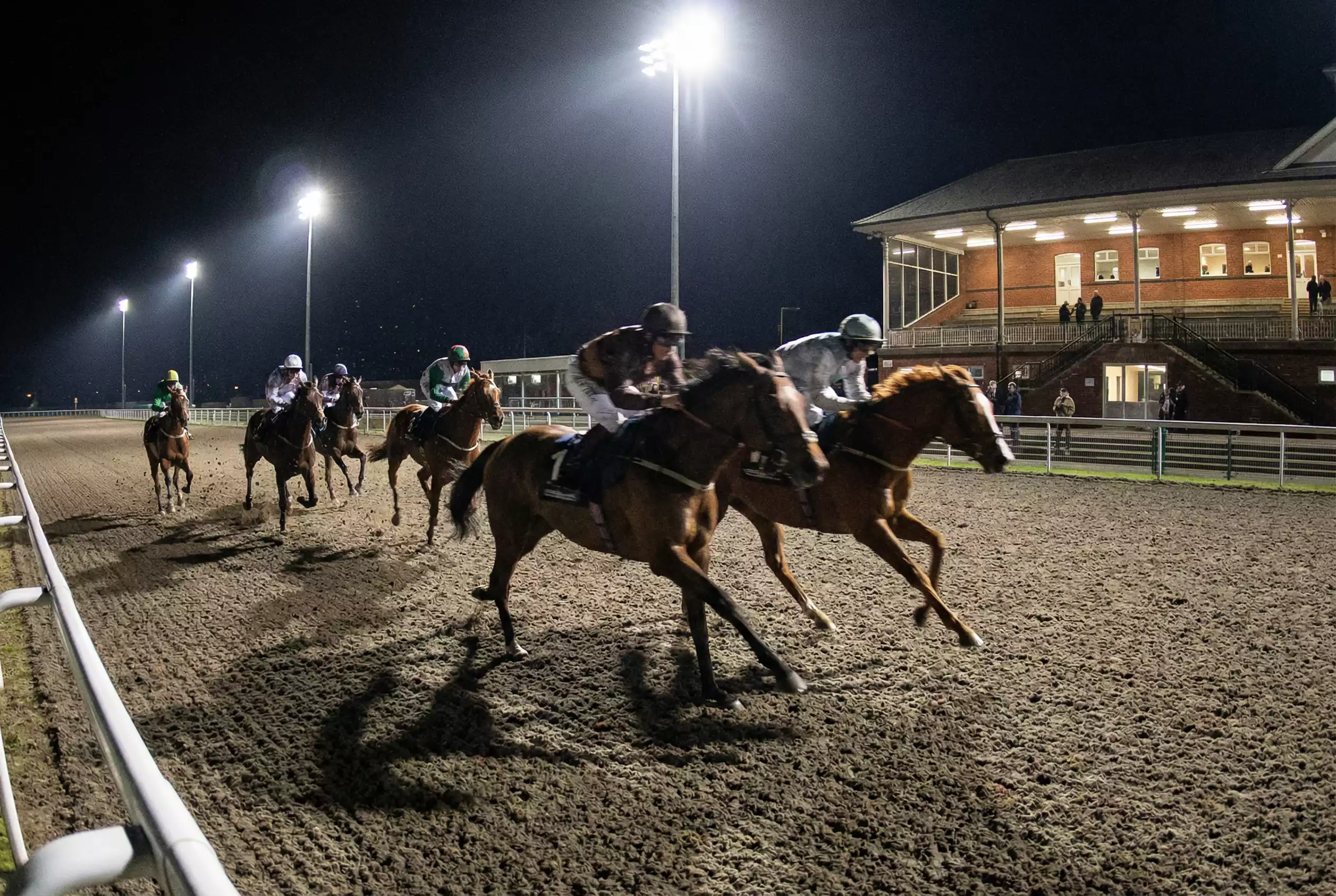
Why In-Play Markets at Wolverhampton Behave Differently
In-play betting on horse racing is a different discipline from pre-race punting. The odds shift in real time as the race unfolds, and the bettor who can read a race faster than the algorithm updates the price has a window — sometimes just seconds — to find value. At Wolverhampton, the in-play dynamics are shaped by the track’s distinctive layout: a tight, left-handed oval with a short home straight, run on a Tapeta surface that produces consistent footing and predictable pace patterns. These characteristics create an in-play environment that differs from wider, galloping tracks where races are more open and the market adjusts more gradually. In-Play Betting at Wolverhampton — More on this topic at wolverhampton race betting.
Understanding in-play betting dynamics at Wolverhampton is a niche skill, but it is one that the venue’s year-round programme gives ample opportunity to develop. With more than eighty fixtures annually — many of them streamed live by the major bookmakers — Wolverhampton is the most accessible venue in Britain for building a dataset of in-play observations. The question is not whether in-play betting works here, but which specific patterns the track geometry produces and how to exploit them.
Wolverhampton’s In-Play Market Profile
Wolverhampton’s in-play market profile is defined by the track’s physical constraints. The short home straight — roughly two and a half furlongs — means that the complexion of a race often becomes apparent later than at a galloping track. A horse leading by two lengths turning into the straight at Newmarket, where the run-in is over three furlongs, faces a sustained test that gives the market time to assess the situation. At Wolverhampton, that same horse turning for home has less ground to cover, which compresses the window in which the in-play price adjusts.
The tight bends create another distinctive feature. Horses racing wide through Wolverhampton’s turns lose more ground than they would on a wider course, and the visual impression of a horse travelling well on the outside can be misleading. In-play bettors watching a live stream need to account for this: a horse that looks to be cruising in third place on the outside of the bend may be using more energy than it appears, and its price may be shorter than the true probability warrants.
Wolverhampton ranks last among all-weather tracks for front-runner performance when aggregated across all distances, according to DrawBias.com. This statistic is directly relevant to in-play bettors because it means the in-play favourite — often the horse leading the race — is more likely to be caught at Wolverhampton than at other all-weather venues. The market tends to over-price leaders on this track, particularly at middle distances where the race is long enough for closers to make up ground. If you are laying horses in-play, Wolverhampton offers a structural edge against leaders that other tracks do not.
Volume of traded in-play money at Wolverhampton is moderate. The venue’s evening-card profile means that in-play activity peaks during the UK evening, when many casual bettors have finished for the day. Exchange liquidity on Betfair for a typical Wolverhampton handicap is lower than for a Saturday afternoon fixture at Ascot or Newmarket, which has two implications: it is easier for a single bet to move the price, and it can be harder to get matched at the odds you want. Speed matters.
The 1.01 Losers: Pace Data for Live Bettors
The most striking in-play statistic at Wolverhampton is the frequency of 1.01 losers — horses that traded at odds of 1.01 on the exchanges during the race (meaning the market considered them a virtual certainty to win) and still lost. Wolverhampton recorded 44 such losers from 3,684 qualifying cases, ranking it 25th out of 39 UK flat courses according to DrawBias.com. That figure — roughly 1.2 per cent of the time — sounds small, but it is meaningful in a market where traders assume that a horse at 1.01 is effectively unbeatable.
For the in-play layer — a bettor who opposes the market leader by offering to take the other side of the bet — this data is the foundation of a strategy. If a horse at 1.01 loses 1.2 per cent of the time, laying it at those odds produces a small but theoretically positive expected return. The challenge is practical: the stakes involved at 1.01 are large relative to the potential profit, and a single losing lay wipes out many winning ones. This is a high-volume, low-margin strategy that requires discipline and a large enough bank to absorb the inevitable clusters of losses.
Where the pace data becomes more useful for the average in-play bettor is in identifying situations where a 1.01 loser is more likely. The track characteristics matter here. At sprint distances, where the short straight gives leaders less time to be caught, the 1.01 loser rate is lower — the market is correct more often because the race is effectively over by the time the horse reaches that price. At middle distances, the rate is higher because the extra ground and the tight turns create more opportunities for leaders to tire or lose position.
Races with fast early pace produce more 1.01 losers than steadily run events. A horse that has led at a strong gallop may trade at 1.01 approaching the home turn but empty in the final furlong as the effort tells. Watching the pace of the race — not just the position of the leaders — is the in-play skill that distinguishes profitable traders from those who simply back or lay based on visual position.
In-Play Strategies for the Wolverhampton Layout
Jockey David Probert offered a useful framing for in-play readers when he observed that Wolverhampton “doesn’t especially favour front-runners or hold-up horses.” That balance — no dominant style — is precisely what makes in-play betting at the venue both challenging and rewarding. Unlike tracks where front-runners almost always hold on or closers almost always rally, Wolverhampton produces mixed outcomes that the in-play market sometimes misprices.
The first practical strategy is to watch the early pace and compare it to pre-race expectations. If you identified the likely front-runner before the race and that horse has taken up the lead as expected, the in-play price should already reflect the scenario. But if the expected front-runner has been outpaced and a different horse leads — one you assessed as a mid-division runner — the race dynamics have shifted and the market may lag in adjusting. This is the classic in-play edge: the gap between what the market expected and what is actually happening.
The second strategy is specific to Wolverhampton’s bends. A horse that is racing prominently on the inside rail through the final bend has a positional advantage that is easy to underestimate on a live stream. The camera angle compresses the field and makes the horse on the outside look closer than it is in terms of ground to cover. Backing the inside horse at this point, if the price is still available, is an angle that relies on understanding the track geography rather than the raw speed figures. See also Wolverhampton Placepot Guide.
A third approach suits the patient bettor. At middle distances, the race often develops slowly through the first half-mile, with the field bunched and the in-play prices fluctuating within a narrow range. As the pace lifts entering the back straight, the prices begin to separate. Identifying which horse is travelling best at that point — before the market fully adjusts — offers a brief window to back at value. This requires watching the race live rather than relying on the price chart alone, and it rewards the bettor who has done the pre-race homework to know which horses finish their races strongly.
