
 Available in US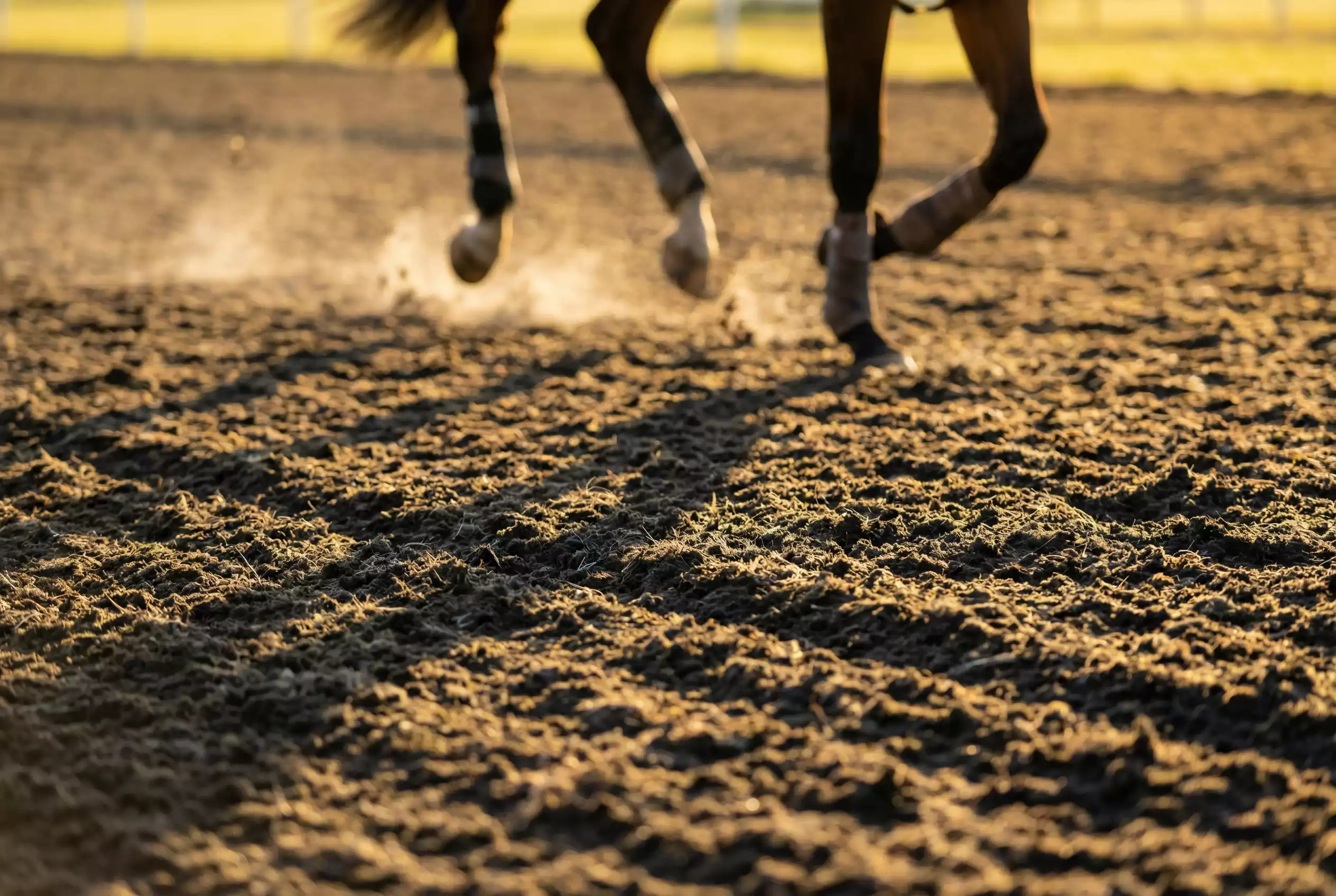
The Surface That Shapes Every Race at Dunstall Park
Every selection at Wolverhampton starts with the same variable, whether punters acknowledge it or not: the ground beneath the horses’ hooves. Dunstall Park doesn’t race on turf. It doesn’t race on Polytrack. It races on Tapeta — a synthetic surface engineered in a laboratory, refined across two decades of iterations, and laid to a depth that fundamentally alters how speed, stamina and running style translate into results. If you’re betting at Wolverhampton without understanding what Tapeta does to a race, you’re essentially backing form compiled on a different sport. Tapeta Surface at Wolverhampton — More on this topic at wolverhampton race betting.
That sounds dramatic, but the numbers bear it out. Horses that thrive on soft turf often struggle here. Frontrunners that dominate at Kempton can flounder on Wolverhampton’s tighter turns. And draw biases that barely register at six furlongs become race-defining at a mile. All of these patterns trace back, directly or indirectly, to the composition and behaviour of the Wolverhampton Tapeta surface. It is the single most important piece of context a bettor can bring to any card at Dunstall Park.
Wolverhampton hosts more than 80 fixtures a year, making it one of the busiest all-weather venues in Britain. That volume generates an enormous pool of form data — but it also creates a trap. Punters see familiar names, check recent results, and assume normal form study applies. What they miss is that Tapeta’s characteristics filter performance in ways that traditional going descriptions can’t capture. A horse listed as running on “standard” at Wolverhampton is running on a surface that behaves nothing like “standard” at Lingfield’s Polytrack or Newcastle’s older Tapeta installation.
This guide breaks down exactly what Tapeta is, how it was developed, what the safety data reveals, and — crucially — how its properties shape the outcomes that matter to anyone placing a bet. We’ll cover composition, injury statistics, the evolution from Tapeta 1 through to the current Tapeta 10, weather effects, and the head-to-head comparison with Polytrack that every serious all-weather punter needs to understand. Tapeta’s impact on Wolverhampton racing touches every angle of form analysis, and by the end of this piece, you’ll know precisely how.
What Tapeta Is Made Of
Tapeta is not a brand name slapped onto generic sand. It is a proprietary synthetic racing surface developed by Michael Dickinson — a former champion jumps trainer turned materials engineer — through a process that has more in common with industrial R&D than traditional groundskeeping. The composition is specific: a blend of specially selected fibres, waxes, recycled PVC granules and silica sand, laid to a depth of up to seven inches over a porous base. Each component serves a defined mechanical purpose, and the ratios are calibrated to produce consistent biomechanical feedback under the hoof.
The sand provides the structural body. It’s the load-bearing element, giving the surface enough firmness to support a galloping thoroughbred at speed without compacting into the kind of jarring hardness you find on baked turf. But sand alone would shift and churn, especially on tight bends. That’s where the fibres come in. They knit through the sand matrix, providing lateral stability — effectively stopping the surface from shearing apart when a horse plants its hoof at an angle during a turn. Anyone who has watched a horse slip wide on a rain-softened turf bend knows why this matters.
The wax coating serves a dual role. First, it binds the sand-fibre matrix together at a microstructural level, creating a surface that holds its shape between maintenance cycles. Second — and this is critical for consistency — it acts as a moisture barrier. Wax-coated particles don’t absorb water the way raw sand does. Rain falls on the surface, drains through, and the going barely changes. That’s the fundamental engineering advantage of Tapeta over natural turf: it decouples performance from weather. A horse that acts on Wolverhampton’s Tapeta in July will face functionally identical ground in January, barring extreme frost conditions.
The PVC component is less intuitive. Recycled PVC granules are distributed through the mix to add a degree of elasticity — a controlled “give” that absorbs concussive force on impact. Think of them as micro-shock absorbers embedded throughout the racing surface. This is not a cosmetic feature. Research by Dr. Mick Peterson, director of the University of Kentucky’s Racetrack Safety Program, has shaped modern understanding of how surface hardness affects limb loading, and the inclusion of PVC in Tapeta’s formula is a direct response to that research. The goal is to reduce peak impact forces during the stance phase of a gallop, which is when catastrophic limb injuries are most likely to occur.
Below the riding surface sits a drainage layer — typically crushed stone or engineered aggregate — that channels water away from the Tapeta material itself. Wolverhampton’s installation also uses a geotextile membrane to separate the drainage layer from the subsoil, preventing contamination that could clog the system over time. The result is a surface that can handle sustained heavy rain without becoming waterlogged, and that dries back to its standard state within hours rather than days.
What matters for bettors is the practical effect of all this engineering. Tapeta at Wolverhampton produces a surface that rides consistently — the official going is almost always listed as “standard” or “standard to slow.” There is no firm ground, no heavy ground, no yielding patches on the inside rail after three races. That consistency is the first thing any form student should internalise: historical going preferences on turf are largely irrelevant here. A horse that only wins on good-to-soft turf tells you nothing about how it will handle Tapeta, because Tapeta doesn’t behave like any variant of turf.
Safety Record: Tapeta vs Turf vs Dirt
Safety is not a peripheral concern in horse racing. It is the issue that dictates regulatory pressure, public perception, and — increasingly — the long-term viability of the sport itself. In the United States, where dirt surfaces have historically dominated, the catastrophic injury rate has driven legislative action, media scrutiny, and a genuine existential crisis for several major tracks. Against that backdrop, the safety data for synthetic surfaces in general, and Tapeta in particular, is not just relevant to welfare debates. It directly affects the environment in which punters operate: safer tracks mean fewer non-runners due to injury, more consistent fields, and — in the long run — a more predictable betting product.
The numbers are stark. According to the US Jockey Club’s Equine Injury Database, as reported by the European Trainer Magazine, synthetic surfaces record approximately 1.2 catastrophic injuries per 1,000 starts. Compare that with 2.1 per 1,000 on dirt and 1.6 per 1,000 on turf. That puts synthetics at roughly 43% safer than dirt and 25% safer than turf on a per-start basis. These are not marginal differences. They represent a fundamental gap in the biomechanical demands each surface places on the equine limb.
Tapeta, specifically, has produced some of the most impressive safety statistics of any surface type. Presque Isle Downs in Pennsylvania — a Tapeta track — recorded just 0.34 fatal injuries per 1,000 starts in 2018, making it the safest of approximately 100 racetracks in the United States that year. That figure is not a one-year anomaly; Presque Isle has consistently appeared near the top of American safety rankings since switching to Tapeta. The track’s design — a one-mile oval with Tapeta as the primary surface — bears meaningful comparison to Wolverhampton’s own layout.
“Our number one goal has always been safety and we also want a level playing field for the horses,” Michael Dickinson, the inventor of Tapeta, told Gulf News. That philosophy is embedded in the product’s engineering. The concussion impact data reinforces the point: according to research cited by Tapeta Footings, horses experience approximately 50% less concussive loading on Tapeta compared to conventional dirt surfaces. Concussive force — the peak impact transmitted through the limb during the stance phase of a gallop — is the primary mechanical driver of stress fractures and catastrophic breakdowns. Reducing it by half doesn’t just save horses. It changes the injury profile of an entire racing programme.
For Wolverhampton bettors, the safety data has practical implications beyond welfare. Tracks with lower injury rates tend to have fewer late withdrawals, which means the declared field is more likely to resemble the actual field at post time. Fewer veterinary scratches means fewer disrupted multiples, fewer voided bets, and more reliable ante-post markets. It also means that horses campaigned regularly at Wolverhampton are less likely to suffer the kind of cumulative limb damage that causes unexplained form dips — the silent killer of many a well-researched selection.
There is a secondary effect worth noting. Because Tapeta produces less concussive stress per run, trainers can — and do — campaign horses at higher frequency on the surface. This is particularly visible at Wolverhampton, where some trainers run their charges every two to three weeks during the winter all-weather season. The reduced physical toll allows for tighter scheduling without the same injury risk, which in turn produces the volume of form data that makes Wolverhampton such a rich environment for statistical analysis.
None of this means Tapeta is injury-proof. Horses still break down on synthetic surfaces, and freak injuries occur regardless of the material underfoot. But the aggregate data is unambiguous: Tapeta tracks are measurably safer than both turf and dirt alternatives, and Wolverhampton’s surface sits within a product lineage that has demonstrated that advantage repeatedly across different installations and racing jurisdictions.
Twenty Years of R&D: From Tapeta 1 to Tapeta 10
The Tapeta surface currently installed at Wolverhampton is not the same product that first appeared on a racecourse. It is the tenth major iteration — Tapeta 10 — the result of more than twenty years of continuous research and development. That timeline matters because it means every version has been tested under racing conditions, evaluated against injury and performance data, and revised. This is not a surface that was designed once and deployed. It is a surface that has been engineered, broken, rebuilt, and refined across two decades of competitive use.
Michael Dickinson’s journey to Tapeta began not in a laboratory but on a training gallop. “Vincent O’Brien ignited my passion for racing surfaces,” Dickinson has said. “It was he, in fact, who invented the modern all-weather gallop. I thought it would take me three months to develop, but it took me four years to perfect.” That four-year initial development cycle produced the first commercial Tapeta product, but Dickinson treated it as a starting point rather than a finished article. Each subsequent installation — at racetracks in the US, UK, Middle East and beyond — generated performance data that fed back into the next version.
The early iterations focused primarily on getting the basic formula right: the sand-to-fibre ratio, the wax coating methodology, and the drainage engineering. Tapeta 1 through 3 were essentially proof-of-concept surfaces, demonstrating that a synthetic product could provide consistent going across weather conditions without the maintenance headaches of first-generation all-weather materials. These versions were installed at training facilities and minor tracks, where they could be monitored without the pressure of a full commercial racing schedule.
From Tapeta 4 onwards, the focus shifted to biomechanical performance — specifically, reducing concussive impact and improving the surface’s response to high-speed galloping. This is where the PVC granule component became increasingly refined. Earlier versions used a relatively crude recycled PVC blend; later iterations introduced graded particle sizes that produced a more uniform distribution of shock-absorbing material throughout the surface depth. The difference is measurable: each successive version has shown incremental reductions in peak impact force under laboratory testing conditions.
Tapeta 7 and 8 introduced improvements to the wax coating process, shifting from a batch-coating method to a continuous-flow system that produced more even coverage on individual sand particles. This might sound like a trivial manufacturing detail, but it had a direct effect on surface consistency. Unevenly coated particles produce uneven drainage, which produces subtle variations in going across different sections of the track. The continuous-flow process eliminated much of that variability, which is one reason why modern Tapeta installations show remarkably uniform performance data across the inner, middle and outer sections of a course.
Tapeta 10, the current version, represents the cumulative benefit of all preceding iterations. It uses the optimised PVC grading from versions 5 and 6, the improved wax process from versions 7 and 8, and a fibre blend that was recalibrated after long-term durability testing revealed that certain fibre types degraded faster than others under UV exposure. The result is a surface that holds its performance characteristics for longer between resurfacing cycles, drains more efficiently, and provides a more consistent biomechanical profile than any previous version.
For bettors, the practical takeaway is straightforward: Wolverhampton’s current surface is a mature product, not an experiment. The data generated on Tapeta 10 is more reliable than data from earlier installations elsewhere, because the surface itself has fewer of the inconsistencies that plagued earlier versions. When you analyse five-year trends at Wolverhampton, you’re working with data produced on a stable, well-understood material — and that stability is what makes form study on Tapeta genuinely useful rather than decorative.
How Weather Conditions Affect the Tapeta Track
The central promise of any all-weather surface is in the name: races go ahead regardless of conditions. Wolverhampton’s Tapeta delivers on that promise more consistently than most, but “all-weather” does not mean “weather-proof.” Conditions still affect the track — just in different ways than they affect turf, and with a narrower range of variation that changes the calculus for bettors.
Rain is the most common weather variable at a West Midlands racecourse, and it is also the one that Tapeta handles best. The wax-coated particle structure repels water at the granular level, meaning rainwater passes through the surface layer and into the drainage system below rather than being absorbed into the racing material. In practice, this means that a card run during steady rainfall will produce going conditions that are functionally identical to a card run in dry weather. The official going description at Wolverhampton is “standard” for the vast majority of fixtures, and it stays there through all but the most extreme precipitation events.
That consistency is the single most important weather-related fact for bettors. On turf, rain transforms the form book. Horses with soft-ground pedigrees suddenly become viable; confirmed good-ground performers become risky propositions. None of that applies at Wolverhampton. A horse’s Tapeta form is its Tapeta form, regardless of what the sky is doing on race day. This eliminates an entire layer of going-related uncertainty that turf punters must navigate, and it means that historical strike rates and level-stakes profit figures at Wolverhampton are more directly comparable across seasons than equivalent data from any turf course.
Cold weather introduces a different set of considerations. Tapeta can freeze in prolonged sub-zero temperatures, and when it does, the surface becomes harder and less forgiving. Wolverhampton has lost fixtures to frost — not many, given its West Midlands location and the insulating properties of the wax coating, but it happens. More importantly, near-freezing conditions can subtly alter the surface even when a meeting goes ahead. A Tapeta track at two degrees above zero is marginally firmer than one at twelve degrees, because the wax component stiffens as temperatures drop. The difference is small enough that the going description doesn’t change, but it may affect horses that are particularly sensitive to surface firmness.
For betting purposes, the cold-weather effect is worth monitoring in the dead of winter — roughly December through February — when Wolverhampton hosts a disproportionate share of the all-weather fixture list. If morning temperatures at Dunstall Park are near freezing, frontrunners and speed horses tend to benefit slightly, because the firmer surface rewards efficient, low-energy running styles. Hold-up horses, which rely on the surface having enough give to sustain a late surge, can find the ground less obliging. The effect is marginal, and it would be unwise to build an entire strategy around it, but it is there in the long-term data as a tiebreaker in close-call selections.
Hot, dry summers have essentially no effect on Tapeta. Unlike turf, which can bake to jarring firmness in a drought, Tapeta’s wax coating prevents the evaporation cycle that dries out natural ground. The surface does not crack, does not develop hard patches, and does not require the irrigation that turf courses rely on to maintain safe going. Wolverhampton’s summer cards race on the same surface as its winter cards, which is exactly the point.
Wind is the one weather factor that occasionally creates a tactical wrinkle. Wolverhampton’s tight oval means that runners face a headwind on one section of the track and a tailwind on another, and the relative positions of these sections vary by distance. On particularly blustery days, frontrunners setting the pace into a headwind on the back straight can tire earlier than expected, giving hold-up horses a marginal advantage. Again, this is a second-order effect — but in a sport where margins are thin, second-order effects are where the value lives.
Tapeta vs Polytrack: What Matters for Bettors
British all-weather racing runs on two surface types: Tapeta and Polytrack. Three of the six UK all-weather tracks now race on Tapeta — Wolverhampton, Newcastle and Southwell (which switched from Fibresand in 2021). The remaining three, Chelmsford City, Lingfield and Kempton, use Polytrack. For bettors who follow horses across multiple all-weather venues, understanding the differences between these surfaces is not optional — it is the starting point for any cross-track form analysis.
Polytrack is also a synthetic surface, and at first glance it sounds similar: a mixture of sand, fibres and a binding agent laid over a drainage base. But the engineering philosophy is different. Polytrack uses a higher proportion of recycled rubber and a different binding compound, which gives it a slightly softer, more “giving” feel under hoof. Horses running on Polytrack tend to sink fractionally deeper into the surface with each stride, which absorbs more energy during the stance phase and — in theory — produces a less jarring ride. The trade-off is that Polytrack can feel heavier to run on, particularly over longer distances. Staying power matters more on Polytrack than it does on Tapeta.
Tapeta, by contrast, rides firmer. The wax-coated sand and PVC blend creates a surface that offers less vertical displacement per stride, meaning horses are effectively “bouncing” off the ground more efficiently. This favours speed horses and runners with an economical, ground-covering action. It penalises horses that dig deep into the surface — the heavy-footed, round-actioned types that can power through Polytrack but find Tapeta unforgiving of mechanical inefficiency.
The practical effect is visible in cross-track form. A horse that wins impressively at Lingfield (Polytrack) does not automatically reproduce that form at Wolverhampton (Tapeta). The surfaces reward different physical attributes, and the form translation is far from one-to-one. As a rough guide, horses that move fluently and carry their speed without visible effort tend to transfer well from Polytrack to Tapeta. Horses that grind out victories through stamina and willpower — the types that improve for a step up in trip on Polytrack — often find Tapeta’s firmer profile less cooperative.
Drainage behaviour also differs. Both surfaces are designed to handle rain, but Tapeta’s wax-coated particles shed water faster, meaning the surface returns to its baseline condition more quickly after heavy rainfall. Polytrack absorbs slightly more moisture before the drainage system takes over, which can produce a temporary “dead” feel in the surface during prolonged downpours. This difference is usually invisible in the going reports — both surfaces are described as “standard” the vast majority of the time — but it can influence pace bias on days when rain arrives during a meeting rather than before it.
Speed figures highlight the difference clearly. Comparable races at Wolverhampton and Lingfield — same class, same distance, similar field sizes — routinely produce different time profiles. Wolverhampton races tend to be run marginally faster in the early stages, because the firmer Tapeta surface encourages higher cruising speeds. Lingfield races tend to have a stronger finishing effort, because the Polytrack’s energy-absorbing properties slow the pace early and leave more in the tank for the final furlong. Bettors who use raw times or speed ratings without adjusting for the surface difference are working with contaminated data.
For anyone building a systematic approach to all-weather betting, the Tapeta-Polytrack distinction should be treated as seriously as the good-to-firm versus soft distinction on turf. They are, functionally, different going types — and form on one does not guarantee form on the other. Wolverhampton’s Tapeta surface sits at the firmer, faster end of the synthetic spectrum, and the horses that thrive here are the ones whose action and temperament suit those conditions.
Enjoy the Racing, Respect the Budget
Betting on horse racing should be an enjoyable activity, not a source of financial or emotional stress. Set a budget before each meeting and stick to it, regardless of results. Never chase losses — the urge to recover a bad run with bigger stakes is one of the clearest warning signs that betting has moved from entertainment to compulsion. Use the deposit limits and cooling-off tools offered by all licensed UK bookmakers; they exist precisely for moments when self-discipline feels difficult. See also Wolverhampton Draw Bias by Distance.
If you feel that gambling is affecting your wellbeing or relationships, help is available. BeGambleAware offers free advice, support and counselling. GamStop allows you to self-exclude from all UK-licensed online gambling sites in a single step. You can also contact the National Gambling Helpline on 0808 8020 133, available 24 hours a day. Recognising a problem early is not a weakness — it is the smartest decision you can make.
