
 Available in US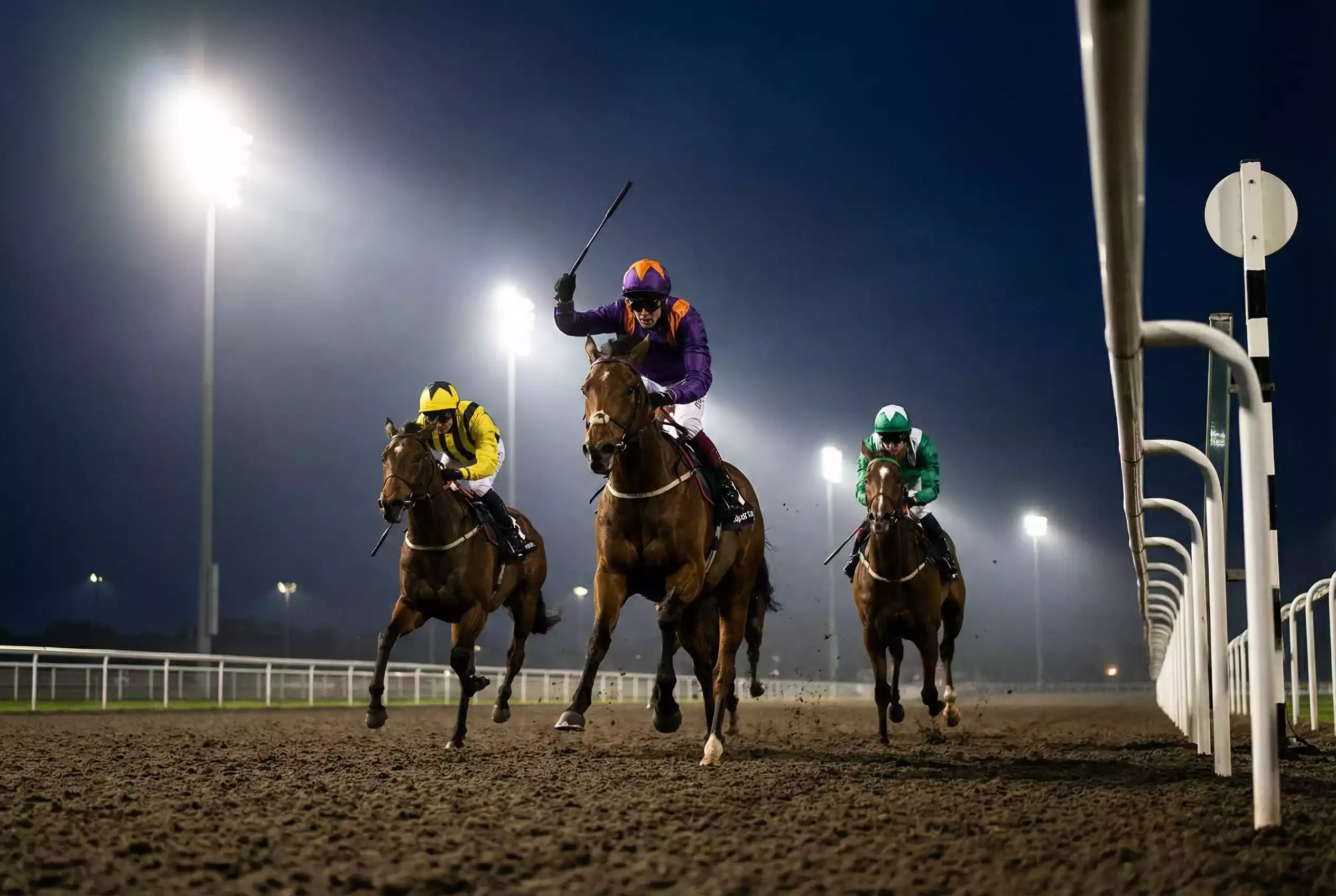
- The Races That Define Wolverhampton's Calendar
- Lady Wulfruna Stakes: History and Significance
- Lady Wulfruna Trends: Favourites, Draw, and Time
- Betting the Lady Wulfruna: Practical Angles
- Lincoln Trial: Wolverhampton's Flat Season Preview
- Lincoln Trial Trends and Form Lines
- The All-Weather Championships Pathway from Wolverhampton
- Feature-Race Excitement, Everyday Discipline
The Races That Define Wolverhampton’s Calendar
Wolverhampton’s bread and butter is the midweek all-weather card: ten-runner handicaps under floodlights, routine racing that keeps the fixture list ticking and the betting turnover flowing. But scattered through that year-round programme are races that carry genuine significance — events where the quality steps up, the prize money rises, and the form has implications beyond Dunstall Park itself. Lady Wulfruna Stakes betting sits at the centre of that calendar, and understanding Wolverhampton’s biggest races is essential for any punter who takes all-weather form seriously. Lady Wulfruna Stakes & Key Wolverhampton Races — More on this topic at wolverhampton race betting.
The Lady Wulfruna Stakes is the headline act: a Listed race that attracts pattern-class performers to a track more commonly associated with lower-grade handicaps. The Lincoln Trial occupies a different role — a recognised prep race for the Doncaster Lincoln, which traditionally opens the flat turf season. And the All-Weather Championships pathway connects Wolverhampton’s regular programme to a season-ending finale at Lingfield that carries more than a million pounds in prize money.
Each of these races offers distinct betting angles that don’t apply to ordinary Wolverhampton cards. The Lady Wulfruna has trend data stretching back two decades, with clear patterns in favourite performance, draw effect and winning times. The Lincoln Trial produces form lines that carry forward to turf, making it one of the few all-weather races where results have direct predictive value for flat season ante-post markets. The Championships pathway turns routine winter handicaps into qualification contests, changing the motivations of trainers and the form profiles of horses throughout the all-weather season.
This guide profiles each of these races individually, examines the statistical trends that inform betting decisions, and explains how the Wolverhampton feature race calendar fits into the broader structure of British all-weather racing. Whether you’re planning a Lady Wulfruna bet months in advance or looking for qualification angles in winter handicaps, the data and context start here.
Lady Wulfruna Stakes: History and Significance
The Lady Wulfruna Stakes — named after the Anglo-Saxon noblewoman who founded the city of Wolverhampton — was first run in 2002 and achieved Listed status in 2007. It is contested over seven furlongs and 36 yards on the Tapeta surface, restricted to horses aged four and above, and is typically staged in early March. In the hierarchy of British all-weather racing, it occupies a unique position: not quite a Group race, but significantly above the standard Wolverhampton card in quality, prestige and prize money.
The significance of the Lady Wulfruna extends beyond its prize fund. It serves as a marker race for the all-weather season — one of the few opportunities for trainers to test pattern-calibre horses on a synthetic surface against genuine competition before the turf season begins. Horses that run well in the Lady Wulfruna regularly appear in Group races on turf within weeks, which means the race produces form lines that resonate well beyond Dunstall Park.
The favourite record provides immediate context for bettors. Over the last 20 runnings, market favourites have won eight times — a strike rate of 40%, according to OLBG trend analysis. That figure is marginally above the average for Listed races on British all-weather tracks, suggesting that the market does a reasonable but not outstanding job of identifying the winner. In practical terms, it means the favourite is a viable bet roughly two years in five, but backing the favourite blindly over a long series would produce a modest loss due to the short odds typically available.
The 60% of renewals won by non-favourites is where the interest lies. The Lady Wulfruna attracts small but competitive fields — usually eight to twelve runners — and the quality gap between the favourite and the third or fourth choice in the market is often narrower than the odds suggest. Trainers use the race tactically: some are targeting it as a primary objective, while others are using it as a stepping stone to higher targets and may not have their horse fully wound up. That divergence in intent creates value for bettors who can read the race conditions and identify which runners are here to win and which are here to learn.
The race’s status as a Listed event also affects the type of horse that contests it. These are not the habitual all-weather plodders that populate Wolverhampton’s regular cards. They are flat-bred, often turf-campaigned horses that drop onto the all-weather surface for a specific objective. Previous all-weather form is a useful guide, but it is not the only form that matters — many Lady Wulfruna winners have arrived with their best recent efforts on turf.
Richard Wayman, the BHA’s Director of Racing, has acknowledged both the strengths and pressures facing the sport’s calendar: major meetings and races performed strongly in 2025, though challenges remain with the horse population continuing to decline and the betting environment presenting ongoing difficulties, as noted in the BHA’s 2025 Racing Report. In that context, races like the Lady Wulfruna serve a dual purpose — they elevate the profile of all-weather racing as a competitive discipline while providing a betting product that attracts interest from punters who might otherwise overlook the Wolverhampton programme entirely.
Lady Wulfruna Trends: Favourites, Draw, and Time
Trend analysis in a Listed race with 20 years of data is more informative than many punters realise. The Lady Wulfruna’s relatively stable conditions — same course, same distance, same surface, same time of year — create a dataset where patterns are less likely to be noise and more likely to reflect genuine structural features of the race.
The jockey trends are striking. Ryan Moore has won the Lady Wulfruna four times, including three of the last seven renewals, as documented by At The Races. That record suggests more than coincidence. Moore does not ride at Wolverhampton frequently — he picks his spots on the all-weather circuit — and his Lady Wulfruna mounts are typically well-fancied runners from major yards. The combination of a tactical, patient riding style and high-class mounts appears to suit a race that is often run at a false pace, where the ability to produce a well-timed finishing effort is more valuable than early speed.
The draw data for the Lady Wulfruna is less definitive than for regular Wolverhampton racing, partly because field sizes are smaller — typically eight to twelve runners — and partly because the quality of the runners reduces the impact of positional advantage. At ordinary Wolverhampton seven-furlong handicaps, the draw bias is well established and measurable. In the Lady Wulfruna, where the runners are better bred, better trained and ridden by more capable jockeys, the ability gap between horses is larger and the draw effect is proportionally smaller. Low stalls remain marginally preferred, consistent with the general seven-furlong pattern, but the edge is not large enough to use as a primary selection tool in a race of this quality.
Winning times provide a useful contextual filter. The fastest Lady Wulfruna was recorded at 1:25.35 by Mister Universe in 2016; the slowest winning time is 1:28.32, set by Dunelight in 2011, per OLBG data. That three-second range might seem narrow, but in a seven-furlong race it represents roughly six lengths — the difference between a genuinely fast-run, competitive renewal and a slowly run tactical affair decided in the final furlong. Renewals that produce fast times tend to favour horses with proven stamina at the trip, because the pace is honest enough to test staying power. Slowly run editions favour speed horses with a strong turn of foot, because the race becomes a sprint from the two-furlong pole regardless of the nominal distance.
Age trends show a mild bias towards older horses. Four-year-olds and five-year-olds dominate the winner’s roster, with very few winners aged seven or above. This is consistent with the profile of the race as a stepping-stone event: trainers use it for horses that are still progressing, not for veterans on the decline. Horses that have run a solid campaign through the winter all-weather season and enter the Lady Wulfruna fresh from a recent competitive outing have a better record than those arriving after a break.
Recent form on all-weather surfaces is the strongest single predictor. Winners almost always have at least one piece of form at Listed level or above within their last three runs, and the majority have run on an all-weather track within the previous six weeks. Horses stepping back onto the all-weather after an extended turf campaign tend to need a run to reacclimatise, and the Lady Wulfruna rarely forgives that adjustment period.
Betting the Lady Wulfruna: Practical Angles
Armed with the trend data, the practical question is how to convert it into a betting approach. The Lady Wulfruna is a once-a-year event, which means any strategy needs to be efficient — you don’t get 80 opportunities to refine your method the way you do with regular Wolverhampton handicaps.
The first filter is form quality. Eliminate any runner that does not have at least one placing in a Listed race or above within the last twelve months. The Lady Wulfruna is won by pattern-standard performers, not improvers from handicap company. A horse stepping up from a Class 2 handicap win into Listed company can occasionally pull it off, but the strike rate for that profile is low enough that it should be treated as a speculative rather than core selection.
The second filter is surface form. Runners with at least two all-weather outings in their recent form profile outperform those arriving directly from turf. The Lady Wulfruna is held on Tapeta, and while class can override surface inexperience at this level, the trend data is clear: familiarity with synthetic surfaces is a positive predictor. If a horse has never run on an all-weather track, or hasn’t done so for more than six months, that is a negative signal even if its turf form is outstanding.
The third angle is jockey booking. Moore’s record has already been discussed, but the broader point is that jockey upgrades for this race are a strong market signal. When a trainer replaces their stable jockey with a rider booked specifically for the Lady Wulfruna — particularly a rider with a strong all-weather record — it indicates that the horse is being targeted at the race rather than using it as a prep. These targeted runners tend to outperform market expectations, because the commitment embedded in the jockey booking is not always fully reflected in the starting price.
For each-way bettors, the Lady Wulfruna’s typical field size of eight to twelve runners means standard each-way terms apply: a quarter the odds for the first three. In fields of eight or nine, the place terms are tight enough that each-way value is limited — you need genuine confidence in a placing at minimum. In fields of twelve or more, the arithmetic improves, and a horse with a strong each-way profile — consistent placings at the level but not quite good enough to win — becomes a viable proposition at prices of 8/1 or longer.
The ante-post market for the Lady Wulfruna opens several weeks before the race but is thin, with most bookmakers offering early prices on only five or six runners. Ante-post betting in this race carries typical non-runner risk, but it can offer value if you identify a horse before the market fully appreciates its credentials. Early declarations and trial-race results in January and February often provide the information edge that the ante-post price hasn’t yet absorbed.
Lincoln Trial: Wolverhampton’s Flat Season Preview
The Lincoln Trial at Wolverhampton occupies a peculiar niche in the racing calendar: it is an all-weather handicap that matters primarily because of a turf race that takes place weeks later. The Lincoln — the traditional curtain-raiser to the flat turf season at Doncaster — is one of the most popular ante-post betting events of the spring. The Wolverhampton trial, run over a mile on Tapeta, serves as one of the recognised prep races, and form from it is studied closely by both trainers and punters as a guide to the Doncaster race.
The trial is typically staged in late February or early March, giving horses a competitive outing approximately four weeks before the Lincoln itself. For trainers, it provides a fitness test for horses that have been in winter training — a chance to blow away the cobwebs under race conditions without the physical demands of a turf race on potentially testing ground. For bettors, it offers something arguably more valuable: a window into the fitness, form and intent of horses that will contest one of the spring’s major handicaps.
The challenge of using Lincoln Trial form is the surface differential. Wolverhampton’s Tapeta and Doncaster’s turf are fundamentally different racing surfaces, and a horse that handles one does not automatically handle the other. A strong run in the trial demonstrates fitness and competitive sharpness, but it does not prove that the horse will act on good-to-firm or good-to-soft turf at Doncaster. The most reliable form lines from the trial tend to come from horses that have previously shown decent turf form in addition to their all-weather ability — the Lincoln Trial confirms their current wellbeing, while their turf record confirms their surface suitability.
Historically, Lincoln Trial runners that go on to contest the Lincoln itself produce a mixed record. Some run well, confirming the trial form; others disappoint, either because the surface switch doesn’t suit them or because the Doncaster race — with its larger field, wider track and different pace dynamics — asks different questions. The trial is best used as one input among several in Lincoln ante-post analysis, rather than a standalone predictor.
From a pure Wolverhampton betting perspective, the trial is also worth playing as a standalone event. It attracts a field of reasonable quality — trainers with serious Lincoln ambitions send capable horses — and the market often prices runners based on their Lincoln aspirations rather than their Wolverhampton credentials. A horse that is unfancied for the Lincoln but well suited to Wolverhampton’s Tapeta surface and mile distance can represent value in the trial itself, even if it has no realistic chance at Doncaster.
Lincoln Trial Trends and Form Lines
The Lincoln Trial’s trend data is less extensive than the Lady Wulfruna’s, partly because the race has a shorter history as a recognised trial and partly because the form is harder to isolate — the trial is sometimes folded into a broader card rather than staged as a standalone feature. Nevertheless, several patterns emerge from the available results.
Handicap ratings between 85 and 100 produce the bulk of Lincoln Trial winners. Horses rated below 85 rarely have the class to compete, while those rated above 100 are often being prepared for higher targets and may not be fully committed to the trial. The sweet spot is the competent handicapper that needs a competitive outing before tackling the Lincoln: fit, well-handicapped, and running with intent rather than going through the motions.
Front-runners and prominent racers tend to do well in the Lincoln Trial, consistent with Wolverhampton’s general pace bias at a mile. The tight track and relatively short straight reward horses that establish position early, and in a trial context — where not every runner is being asked for a maximum effort — the horse that controls the pace often controls the race. Hold-up horses can win the trial, but they need the pace to be genuinely strong enough to set up a finishing effort, which is not guaranteed in a small-field prep race where several runners may be held up for future engagements.
The strongest form line from the Lincoln Trial to the Lincoln itself tends to come from horses that finish first or second in the trial while being ridden with clear purpose. Horses that finish well back in the trial but are excused by connections on the grounds of needing the run are harder to assess — the explanation may be genuine, but it also provides a convenient narrative for a horse that simply wasn’t good enough on the day. As a general rule, trust what you see on the track rather than what you hear in the post-race interviews.
The All-Weather Championships Pathway from Wolverhampton
Wolverhampton’s regular programme feeds directly into the All-Weather Championships, a season-long competition that culminates in Finals Day at Lingfield Park. The Championships carry a total prize fund exceeding one million pounds — the richest all-weather raceday in Europe — distributed across six category finals covering different distances and race types. For trainers with capable all-weather performers, the Championships provide both a target and a financial incentive that elevates the significance of winter racing from survival to ambition.
The qualification process works on a points-based system. Designated qualifying races are staged at all six UK all-weather tracks throughout the season, with points awarded to the first four finishers. Wolverhampton, with its 80-plus annual fixtures, hosts a disproportionate share of these qualifiers, making it the most important single venue on the Championship pathway. A horse that campaigns regularly at Wolverhampton through the autumn and winter has more opportunities to accumulate qualifying points than one based at a track with fewer fixtures.
That structural advantage shapes trainer behaviour. Yards with realistic Championship ambitions will target specific qualifying races at Wolverhampton, sometimes running horses in events that appear unremarkable on the card but carry Championship points that could prove decisive. For bettors, this creates an information edge: a horse entered in a Wolverhampton qualifying handicap may be running with a different motivation than its rivals. If the connections need Championship points, the horse is more likely to be ridden with intent to finish as high as possible, even if the race itself is not a primary target.
Identifying these Championship-motivated entries requires monitoring the qualification standings, which are published on the All-Weather Championships website. Horses that sit just below the qualification threshold in February and March — when the final qualifying races are being staged — are the ones most likely to be given strong rides at Wolverhampton as connections push for a Finals Day berth. That urgency translates into effort on the track, and effort that the market may not fully price in.
The Championship pathway also affects form analysis in reverse. Horses that have accumulated enough points for Finals Day qualification may be eased in their remaining Wolverhampton starts, because the trainer is now preserving the horse for Lingfield rather than maximising performance at Dunstall Park. A sudden dip in form from a previously consistent Wolverhampton performer during the late winter period should prompt a check of the Championship standings before you mark the horse down as declining — it may simply be being saved for a bigger day.
Finals Day itself, typically staged on Good Friday at Lingfield, provides a postscript to the Wolverhampton season. Horses that qualified through Wolverhampton races carry form from Tapeta into a race on Polytrack, and the surface switch is a relevant factor. Not every horse that thrives on Wolverhampton’s firmer Tapeta will reproduce that form on Lingfield’s slightly softer Polytrack. Bettors who have followed these horses through their Wolverhampton qualifying campaign have an information advantage over those who encounter them cold at Lingfield — you know the horse, its running style, its quirks, and its likely response to a surface change. That familiarity, built over months of all-weather racing, is itself a form of edge.
Feature-Race Excitement, Everyday Discipline
Feature races generate excitement and media coverage, which can encourage larger or more impulsive bets than your usual approach. Treat the Lady Wulfruna, Lincoln Trial and Championship qualifiers with the same staking discipline you apply to any race. A bigger event does not justify a bigger stake unless your analysis — not your enthusiasm — supports it. See also Wolverhampton vs Other All-Weather Tracks.
If you find yourself betting more than you planned, or feeling compelled to recoup losses from earlier on the card, pause and reconsider. Tools like deposit limits and session reminders are available through every licensed UK bookmaker. For independent support, BeGambleAware offers free advice and counselling, and GamStop provides a single self-exclusion service covering all UK-licensed online operators. The National Gambling Helpline is open 24 hours on 0808 8020 133.
