
 Available in US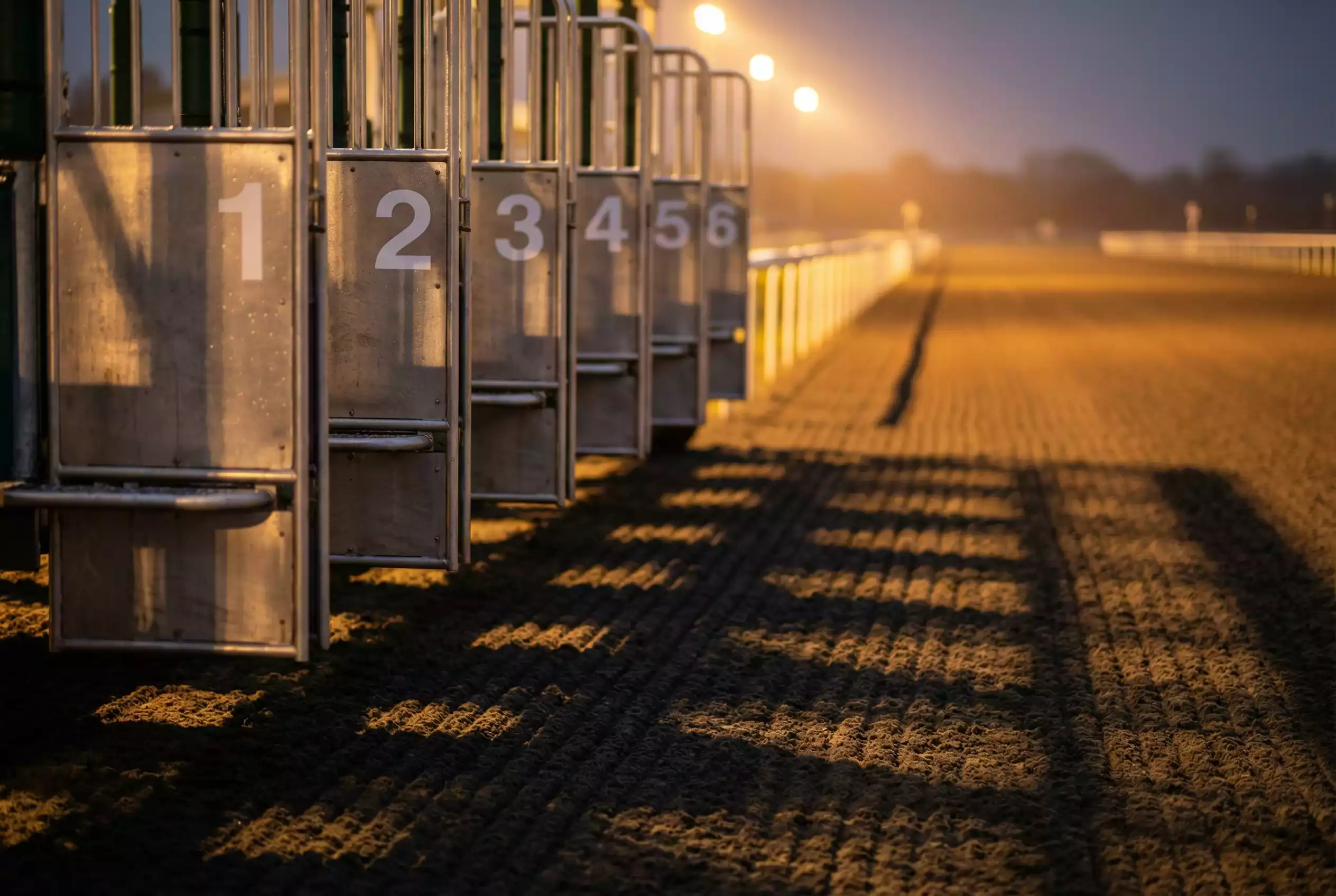
The Sprint Where Stall Position Pays
Five furlongs at Wolverhampton is a race that can be decided before a jockey has time to think. The start sits on a chute that feeds into the main oval with a left-handed bend arriving fast, and where you break from matters more than almost anything else on the racecard. As one jockey noted in an At The Races course guide: the 5f, 7f, and extended mile starts are “very much draw-dependent” with “a big advantage being among the low, left-hand numbers.” That assessment is not opinion. It is confirmed by five years of level-stakes profit and loss data that shows low stalls delivering a measurable edge — but only when the field is large enough to make the bias bite. Wolverhampton 5f Draw Bias — More on this topic at wolverhampton race betting.
This is where 5-furlong draw data at Wolverhampton gets interesting. The bias is not constant. In small fields of six or fewer runners, where every horse has room to find a position, the stall number becomes almost irrelevant. Expand the field to ten or more runners and the geometry of the track takes over, compressing the outside draws into a wider arc through the bend and handing the inside stalls a rail-hugging advantage that no amount of talent can reliably overcome. For anyone who bets on Wolverhampton sprints regularly, understanding where that threshold sits — and how it affects the value in the market — is fundamental.
5f Draw Bias: Stall-by-Stall Performance
The mechanism behind the bias is the left-handed turn that horses negotiate roughly two furlongs from the finish. A horse drawn low — stalls one through four — has a shorter path to the inside rail and can slot in against it without losing ground. A horse drawn high — stall eight or above in a big field — must either use energy to cross over early or accept running a wider arc through the bend, adding several lengths to the overall distance travelled.
Data from DrawBias.com confirms that in big fields of ten or more runners, low starting positions hold a statistically significant advantage at 5 furlongs. This is the only Wolverhampton distance where the draw bias has been consistently verified as significant in large fields over a multi-year sample. It is not a marginal effect. Horses drawn in stalls one to three in these conditions outperform their market-implied probability by a clear margin, while those drawn widest underperform by a roughly equivalent amount.
The bias operates through two channels. The first is pure geometry — shorter distance travelled on the inside. The second is positional. Low-drawn horses in big fields are more likely to secure an early prominent position, which at Wolverhampton’s 5-furlong trip is closely correlated with winning. Front-runners at this distance show a long-term win rate of around 20 per cent in handicaps with eight-plus runners, and those front-runners are disproportionately drawn low because the draw gives them the first run to the rail.
That said, jockey skill can partially mitigate the disadvantage. A sharp rider breaking quickly from stall nine in a twelve-runner field can sometimes angle across to the rail within the first furlong, neutralising the wider draw at the cost of early effort. But “sometimes” is not “often enough to bet on,” and the LSP data over five years shows that this athletic correction does not happen frequently enough to eliminate the bias.
LSP Table: Profit and Loss by Stall (5 Years)
Level-stakes profit (LSP) strips away the noise. It answers a simple question: if you had backed every horse from a given stall at £1 per race over five years, would you have made money or lost it? At Wolverhampton’s 5-furlong distance, the answer varies dramatically by stall position.
Stalls one through three cluster in positive or near-breakeven territory in large-field races, with the lowest stalls showing the strongest returns. The profit is not enormous on a per-bet basis, but it is consistent — the kind of small, repeatable edge that compounds over a long series of bets. Move to stalls four and five and the picture becomes neutral: neither clearly profitable nor clearly unprofitable, depending on the sample period chosen. This is the transition zone where draw advantage fades without yet becoming a disadvantage.
From stall six outward, the numbers turn negative. The losses deepen as the stall number rises, with the outermost draws in twelve-plus runner fields showing some of the steepest LSP deficits on the entire Wolverhampton card. These are not marginal losers; they are horses that the market prices as if the draw does not exist, when the data says it very much does.
A word on sample size: LSP figures are noisier for higher stall numbers because those stalls are only occupied when the field is large. Stall twelve might have a dramatic profit or loss figure, but it is based on far fewer data points than stall one. The pattern across the full range is what matters — a clear gradient from low (profitable) to high (unprofitable) — rather than any single stall’s isolated number. Treat the gradient as the signal, not any individual cell.
Big Fields vs Small Fields: When the Draw Bites
Field size is the switch that turns the draw bias on or off. The average flat field size in Britain stood at 8.90 runners in 2025 according to the BHA Racing Report, with premier fixtures averaging 11.02. Wolverhampton’s typical field falls close to that national average, but the distribution is skewed: sprint handicaps frequently attract double-figure fields while novice and maiden events over the same distance may have only five or six runners.
In small fields — six runners or fewer — the data shows no meaningful draw advantage at 5 furlongs. Every horse has space to find a position without interference, and the bend creates less compression because there is more room on the track. Backing low draws in these races purely on the basis of stall position is not a strategy; it is superstition dressed up as analysis.
The threshold sits around eight to nine runners. Below that, the effect is too weak to exploit. Above it, and particularly once you reach ten or more, the low-draw advantage becomes statistically robust and practically significant. The key for bettors is to filter. Before considering stall position, check the declared runners. If the field is small, ignore the draw and focus on form, pace, and trainer angles. If the field is large, incorporate the draw as a genuine factor — weight the low stalls upward in your assessment and be sceptical of high-drawn runners whose price does not compensate for their positional handicap. See also Wolverhampton 1 Mile Draw Bias.
One practical approach is to treat the draw as a tiebreaker rather than a primary selection criterion. When two horses look equally matched on form, pace, and class, and one is drawn in stall two while the other sits in stall ten in a twelve-runner sprint, the draw is a legitimate reason to side with the lower number. Used this way — as a filter rather than a system — the 5-furlong draw bias at Wolverhampton becomes a durable edge rather than a mechanical rule that periodically fails.
