
 Available in US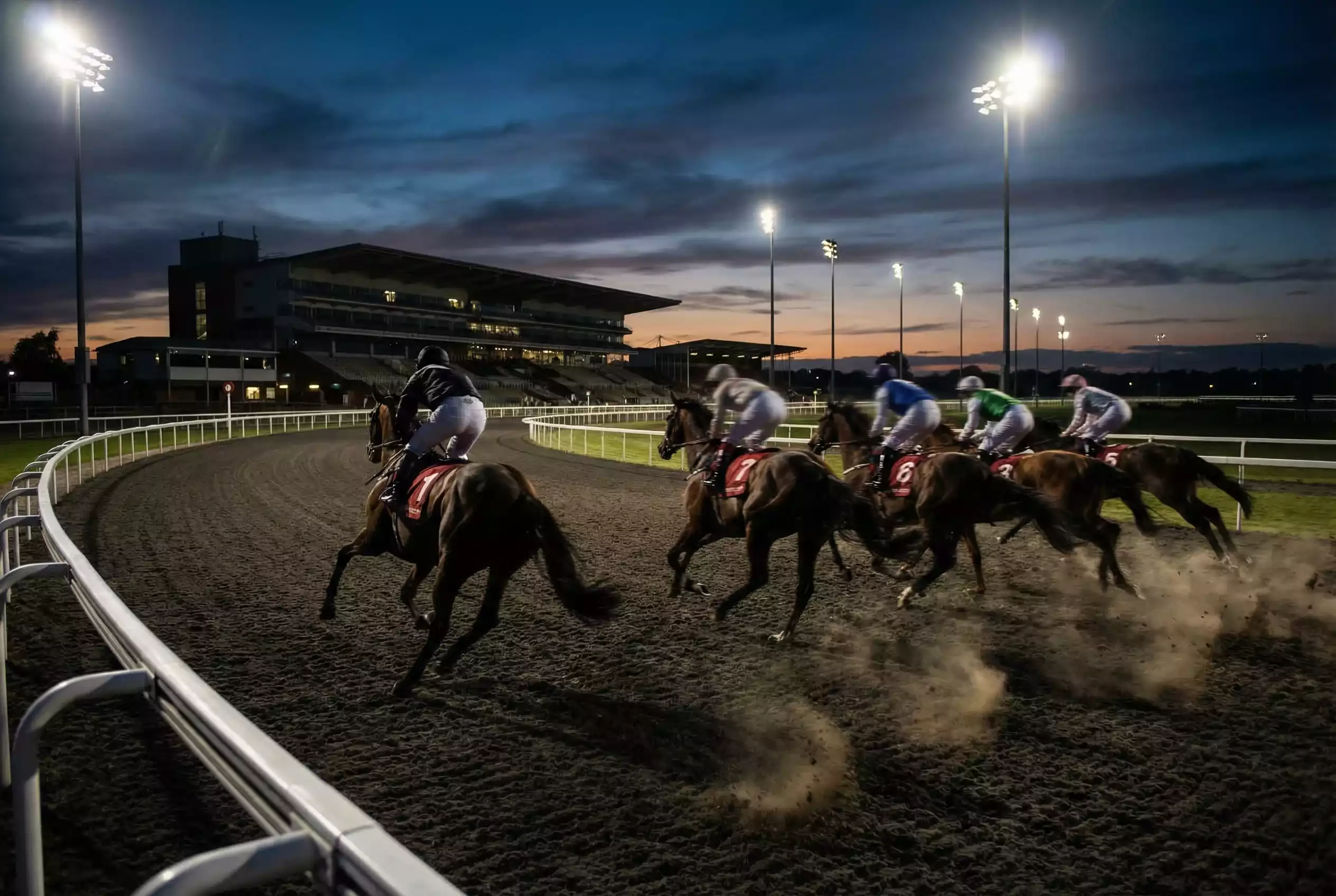
Wolverhampton’s Most Biased Distance
Every racecourse has a distance where the track configuration punishes bad draws harder than the form book can rescue. At Wolverhampton, that distance is one mile. The extended mile start — officially 1m 141 yards — produces the course’s most pronounced stall bias, stronger than the 5-furlong sprint bias and far stronger than the essentially neutral 6-furlong distribution. According to DrawBias.com, the one-mile draw bias in favour of low stalls is the most marked of any distance at the venue. Wolverhampton 1 Mile Draw Bias — More on this topic at wolverhampton race betting.
Understanding the one-mile draw bias at Wolverhampton is not optional for regular bettors at Dunstall Park. It shapes which horses can win from which stalls, how pace scenarios unfold, and where the market consistently misprices runners. A horse with strong form drawn in stall ten in a competitive mile handicap is not the same proposition as the same horse drawn in stall two, and the gap between those two scenarios is wider here than at any other all-weather track in Britain. The data does not whisper. It shouts.
1-Mile Draw Landscape: How the Start Position Works
The geography of the mile start explains almost everything. Wolverhampton’s 1m 141y start is positioned on the far side of the oval, meaning the field must negotiate a left-handed bend within the first two furlongs before settling onto the back straight. This is not a gradual curve; it is a reasonably tight turn on a track that measures approximately one mile in circumference. The horse drawn lowest has the shortest route to the inside rail and can establish a position against it with minimal effort. The horse drawn widest must either burn energy crossing over or accept running several lengths further than its inside rival through the bend.
Unlike the 5-furlong start, where the bend arrives after a short initial straight and the entire race is over in roughly sixty seconds, the mile start feeds into a longer race where the positional damage done in the first two furlongs compounds over the remaining distance. A horse that loses two lengths to the draw through the first turn at 5 furlongs has perhaps three furlongs to recover. At a mile, the same horse has six furlongs, but the energy expenditure required to make up that ground — or the wider racing line accepted to avoid spending it — often tells by the time the field turns for home.
The home straight at Wolverhampton is short, around two and a half furlongs. This matters because it limits the time available for closers to make up ground. A horse that has been shuffled back by a wide draw and raced in the rear half of the field through the first bend faces a narrow window to produce a finishing effort. Even if it has the ability, the track geometry works against it. The combination of a tight first turn and a short finishing straight is what makes the one-mile draw at Wolverhampton structurally biased rather than randomly so.
Rail movements add a secondary layer. When the rail is in its standard position, the inside line through the first bend is tight. When the rail is moved out — as it periodically is to protect the surface — the effective width of the track increases, slightly reducing the draw advantage. Checking the rail position before a meeting is a small piece of due diligence that can refine your assessment of how much weight to give the stall number.
Stall-by-Stall Data at 1m 141y
The level-stakes profit data at 1m 141y follows a steep gradient. Stalls one and two sit comfortably in profit over a five-year sample, with the lowest stalls showing the highest win strike rates relative to their market-implied probability. Move outward and the numbers decay steadily. By the time you reach stalls seven and eight, the LSP figures are firmly negative, and the outermost draws in fields of ten-plus runners show losses that are difficult to explain by anything other than the structural disadvantage of the draw.
What distinguishes the mile from the 5-furlong picture is the consistency of the bias across field sizes. At 5 furlongs, the draw is largely irrelevant in small fields and becomes significant only once the field exceeds eight or nine runners. At a mile, the bias is detectable even in fields of seven or eight — smaller than the national average flat field size of 8.90 runners recorded in 2025. The turn arrives so early in the race, and the track is tight enough, that even moderate fields generate enough compression on the bend to hand low draws a measurable edge.
The implication for bettors is that the one-mile draw should be a standing consideration, not a conditional one. At 5 furlongs, you check the field size before deciding whether to factor in the draw. At a mile, you factor in the draw as a matter of course and adjust for field size only at the margins. In a twelve-runner mile handicap, a horse drawn in stall one has a quantifiable head start over a horse of identical ability drawn in stall eleven. Ignoring that is not a neutral decision — it is an actively bad one.
One caveat: the data captures what has happened, not a guarantee of what will happen in every individual race. A top-class horse drawn wide can still overcome the bias. But across hundreds of races, the pattern is clear and the edge is real. Treat the stall data as a probability adjustment, not a certainty, and it becomes one of the most reliable tools in the Wolverhampton bettor’s kit.
Pace and Draw Interaction on 1 Mile
Draw and pace are entangled at one mile in a way they are not at shorter distances. At 5 furlongs, the race is essentially a drag race: speed from the gate is the dominant factor. At a mile, the pace scenario — how fast the field goes through the first half — interacts with the draw to produce outcomes that neither factor alone can explain.
When the pace is strong — two or three horses racing keenly for the lead through the first bend — the advantage of a low draw is amplified. The low-drawn horse can sit on the rail in a prominent position without expending extra effort, while the high-drawn horse either commits to racing wide through the bend or drops back to find a rail position further back in the field. In a fast-paced race, both options are costly. Racing wide burns energy that tells in the final furlong. Dropping back surrenders position that the short home straight makes difficult to recover.
When the pace is slow — a tactical race with no obvious front-runner — the draw advantage narrows but does not disappear. Even in a slowly run mile, the first bend still compresses the field, and the lowest draws still have the shortest route to the rail. The difference is that in a slow-paced race, the energy cost of being drawn wide is lower because the field is not strung out as aggressively, leaving more time and space to manoeuvre. See also Pace Bias ROI at Wolverhampton.
Wolverhampton ranks last among all all-weather tracks for front-runner performance across the full range of distances, a statistic from DrawBias.com that might seem to contradict the draw-bias story. It does not. The two facts coexist because the draw determines who gets to lead, not whether leading is the optimal tactic. A front-runner drawn low at a mile can dictate the race. A front-runner drawn high must spend effort to cross over and lead, which reduces the energy available to sustain the pace — hence the poor overall front-runner numbers when all draws are aggregated. The data is not contradictory; it is layered. The draw is the lens through which pace bias should be read at this distance, not the other way around.
