
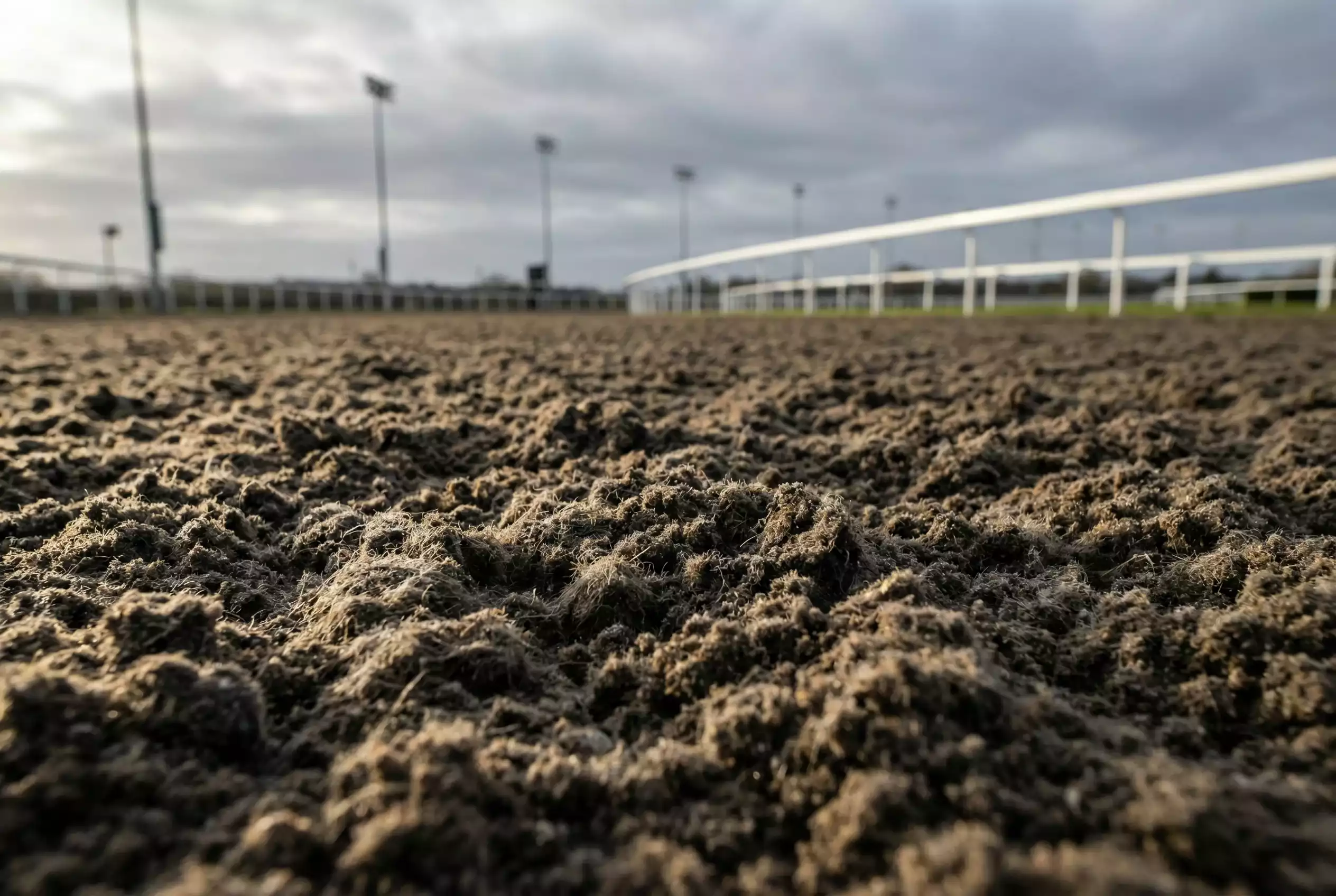
Why the Tenth Generation of Tapeta Matters
Every racing surface tells a story, and at Wolverhampton the story has been rewritten ten times. Dunstall Park’s Tapeta track is not some static installation bolted down in the early 2000s and left to age. It is the product of relentless tinkering — a surface that has evolved through a full decade of iterations while most of its competitors have barely changed their recipe once. Understanding what lies beneath the hooves at Wolverhampton is not an academic exercise; it shapes which horses handle the track, how form translates from turf or other synthetic venues, and ultimately where your money lands.
The current iteration, Tapeta 10, represents more than twenty years of research and development by Michael Dickinson’s team at Tapeta Footings. For bettors, this matters because surface composition directly influences kickback, grip, drainage, and the consistency of times from one meeting to the next. A punter who treats all all-weather tracks as interchangeable is giving away an edge before the stalls even open. Getting inside the Tapeta 10 surface — knowing what it contains, how deep it runs, and what the ground staff do between races — is the first step toward betting on Wolverhampton with something more than guesswork.
Materials and Layering: What Tapeta 10 Contains
Michael Dickinson did not set out to build a racing surface. He set out to reduce the number of horses breaking down on raceday, and the surface became the vehicle. As he put it: “The safety of the horse has always been a long-term goal of mine ever since I was a child.” That ambition produced Tapeta’s first version in the early 2000s, and each subsequent generation has refined the balance between cushioning and responsiveness. The tenth iteration — Tapeta 10 — is the culmination of more than twenty years of continuous R&D, a cycle that few products in any sport can match.
What makes the development arc unusual is the feedback loop. Dickinson’s team collects data from tracks in the UK, the United States, and the Middle East, then adjusts the formula for the next batch. Each version tweaks the ratio of binding agents, the fibre length, or the wax blend. Tapeta 10 arrived at Wolverhampton as the latest output of that process, incorporating lessons learned from installations at Newcastle, Southwell, and international venues such as Meydan and Presque Isle Downs.
The layering approach has always been central. Unlike simple dirt or sand surfaces, Tapeta is engineered as a composite. A compacted base sits beneath a cushion layer that absorbs concussive force, and the riding surface itself sits on top. Tapeta 10 refined the transition between these layers, aiming for more uniform drainage and reduced variation in footing across different sections of the track. For the bettor, the practical effect is consistency — times at Wolverhampton are more comparable meeting-to-meeting than you would find on turf, where ground conditions swing wildly between good and heavy.
Three of the six all-weather racecourses in Britain now race on Tapeta — Wolverhampton, Newcastle, and Southwell, the last of which switched from its old fibresand surface in 2021 (Arena Racing Company). That growing adoption is itself a data point: racecourse operators are investing in Tapeta because its track record on safety and performance has consistently outperformed the alternatives available in the market.
Seven Inches Deep: Surface Composition in Detail
Strip Tapeta 10 down to its raw ingredients and you find four principal components: specially selected fibres, waxes, polyvinyl chloride (PVC), and sand, laid to a depth of up to seven inches. That description, sourced from the All Weather Championships, sounds straightforward enough. It is anything but.
The fibres provide structural integrity. They bind the surface together so it does not shear apart under a galloping horse’s hoof strike, which can exert several tonnes of force per square inch at full speed. The wax component serves a dual purpose: it waterproofs the upper layer, preventing the kind of saturation that turns turf into a bog, and it maintains pliability across a temperature range that matters in a British climate where summer meetings and midwinter fixtures can differ by thirty degrees. PVC granules add elasticity and help the surface spring back after compression, while the sand fraction provides the bulk and drainage characteristics.
The seven-inch depth is not arbitrary. It corresponds to the distance a hoof penetrates at racing speed — deep enough to cushion impact, shallow enough that a horse does not feel as though it is running through treacle. Research by Dr. Pratt found that horses on Tapeta experience roughly 50 per cent less concussion impact compared to conventional dirt surfaces, which is the kind of margin that shows up not only in injury statistics but in how freely horses move through the final furlong.
From a form perspective, the composition matters because it produces what riders often describe as a “dead” surface — not in the sense that it kills speed, but that it absorbs energy more evenly than polytrack or fibresand. Ground variation at Wolverhampton is minimal, which makes speed figures more reliable and reduces the random element that can upend form calculations on turf. When you see a horse clock a consistent set of sectional times across three Wolverhampton starts, you can trust that data in a way that is simply not possible on a turf track where the going changes from race to race.
Maintaining the Track: Harrowing, Watering, and Seasonal Care
A surface is only as good as the maintenance regime behind it, and Wolverhampton’s ground staff follow a detailed protocol to keep Tapeta 10 performing to specification. Harrowing is the backbone of that protocol. Between every meeting — and often between individual races on a busy card — the track is harrowed to redistribute the surface material, fill in divots left by hooves, and prevent compaction. If the top layer packs down too tightly, the cushioning effect diminishes and times slow.
Watering plays a different role on Tapeta than it does on turf. The wax component means the surface does not absorb water in the same way as soil, so irrigation is primarily about temperature management and dust suppression rather than changing the going. In summer, watering keeps the wax component from softening excessively in direct heat, which would make the surface ride slower. In winter, the challenge reverses: frost can harden the top layer, and ground staff may need to harrow more aggressively to break up any crust before racing.
Seasonal care extends to periodic top-ups. Over the course of a year with eighty-plus fixtures, material migrates — kicked to the outside rail on bends, thinned on the racing line, piled up on the inside. The track management team measures depth at regular intervals and adds fresh Tapeta material where needed, a process that happens several times per season. Wolverhampton also schedules an annual deep maintenance window, typically during a quiet period in the fixture calendar, to strip back the surface, check the base layer integrity, and relay the riding surface from scratch if necessary.
For punters, the practical takeaway is simple: check the fixture schedule. A meeting held immediately after a deep-maintenance session can ride differently from one staged at the tail end of a heavy block of fixtures. Rail movements, which shift the running line to protect the surface, also affect draw bias and sectional times. When the rail is in its standard position versus moved out by two or three metres, the effective track width changes — and with it, the dynamics of where front-runners and closers want to be.